
Understanding Facial Ageing: What's Actually Changing Beneath the Surface
Ageing is something we all experience, but very few of us truly understand what is actually happening beneath the surface of our skin as the years pass. At Rejuved on the Central Coast, one of the things we feel most strongly about is education. When patients understand the science of what is changing in their face and why, they're better equipped to make informed decisions about their skin — and to have meaningful, realistic conversations with our team about their concerns and goals.
So let's talk about what facial ageing actually involves. It's more complex — and more interesting — than most people realise.
Ageing Is Not Just About the Skin
This is perhaps the most important thing to understand. When we look in the mirror and notice changes in our appearance over time, we tend to attribute everything to the skin — wrinkles, lines, sagging. But the visible signs of ageing are the result of changes happening simultaneously across multiple layers of the face, not just at the surface.
Facial ageing involves the skin, yes — but also the fat compartments beneath it, the muscles of facial expression, the ligaments that hold everything in place, and even the underlying bone structure itself. Understanding each of these layers helps explain why ageing looks the way it does, and why a thoughtful, holistic approach to facial assessment is so important.
What Happens to the Skin
The skin itself undergoes significant changes over time, driven by a combination of intrinsic ageing — the natural, inevitable biological process — and extrinsic ageing, which is caused by environmental factors, primarily sun exposure.
Collagen and elastin loss Collagen is the protein responsible for the skin's structural integrity — its firmness and density. Elastin is responsible for its ability to spring back after movement. From our mid-twenties, we begin to produce less of both. By our forties and fifties, this reduction is cumulative and visible. The skin becomes thinner, less resilient, and more prone to the formation of lines — particularly in areas of repeated movement like around the eyes, forehead and mouth.
Reduced cellular turnover As we age, the rate at which our skin renews itself slows considerably. In younger skin, the entire surface layer renews roughly every 28 days. This cycle lengthens with age, contributing to a dull, tired appearance and uneven texture. Dead skin cells accumulate more readily on the surface, affecting how light reflects off the skin and reducing that natural luminosity we associate with younger skin.
Changes to the skin barrier The skin's natural barrier — its ability to retain moisture and protect against environmental stressors — also weakens over time. This contributes to increased dryness, sensitivity and a less plump, hydrated appearance overall.
What Happens to the Fat Compartments
Beneath the skin lies a layer of subcutaneous fat, which is not distributed evenly across the face but organised into distinct compartments separated by fibrous walls. In youth, these compartments are well-supported and evenly distributed, giving the face its characteristic rounded, lifted appearance.
With age, these fat compartments undergo significant changes — some deflate and lose volume, while others descend due to the loosening of the ligaments that hold them in place. This is why the face doesn't simply sag uniformly with age, but changes in a more nuanced way — hollowing in some areas while appearing to accumulate volume or heaviness in others.
The tear trough — that hollow that develops beneath the eyes — is largely the result of fat compartment deflation in this area. The deepening of the nasolabial folds — the lines that run from the nose to the corners of the mouth — is driven partly by descent of the mid-face fat compartments above them. Understanding this anatomy is fundamental to any meaningful assessment of facial changes.
What Happens to the Muscles
The muscles of facial expression — the ones we use constantly throughout the day to smile, frown, squint and speak — also contribute to the ageing process in two distinct ways.
Firstly, repeated contraction of these muscles over decades contributes to the formation of dynamic lines — the lines that appear when we make an expression and, over time, become etched into the skin at rest.
Secondly, certain facial muscles weaken and elongate with age, contributing to descent and changes in the overall shape and definition of the face. The interplay between muscle movement and skin quality is one of the reasons facial ageing is so individual — the way we use our faces, our genetics and our lifestyle all influence how and where we age.
What Happens to the Bone
Perhaps the least discussed but most significant driver of facial ageing is what happens to the underlying bone structure. Facial bones are not static — they undergo resorption and remodelling throughout life, and this process accelerates with age.
The orbital rim — the bone surrounding the eye socket — expands and recedes, contributing to the hollowing around the eyes and changes in eyelid position. The maxilla — the bone of the upper jaw — loses volume, which contributes to changes in the projection and support of the mid-face. The angle of the jaw changes, contributing to a less defined jawline and chin projection over time.
These skeletal changes underpin much of what we observe on the surface — which is why a truly thorough facial assessment considers the face in its entirety, not just the skin.
The Role of Lifestyle and Environment
Not all ageing is intrinsic. Environmental and lifestyle factors play a significant role in how quickly and visibly we age.
UV exposure is the single most significant external contributor to skin ageing. Daily, cumulative UV exposure — not just the kind that causes sunburn, but the everyday, low-level exposure we experience through windows, driving and time outdoors — drives collagen breakdown, pigmentation changes and a loss of skin firmness over time.
Smoking dramatically accelerates ageing by restricting blood flow to the skin and generating free radicals that break down collagen and elastin.
Nutrition and hydration affect skin health from within. A diet rich in antioxidants, healthy fats and adequate protein supports the skin's structural integrity. Chronic dehydration visibly affects skin plumpness and resilience.
Sleep and stress also leave their mark. Chronic sleep deprivation and high stress levels elevate cortisol — a hormone that, over time, contributes to collagen breakdown and increased inflammation in the skin.
A Thoughtful Approach to Facial Assessment
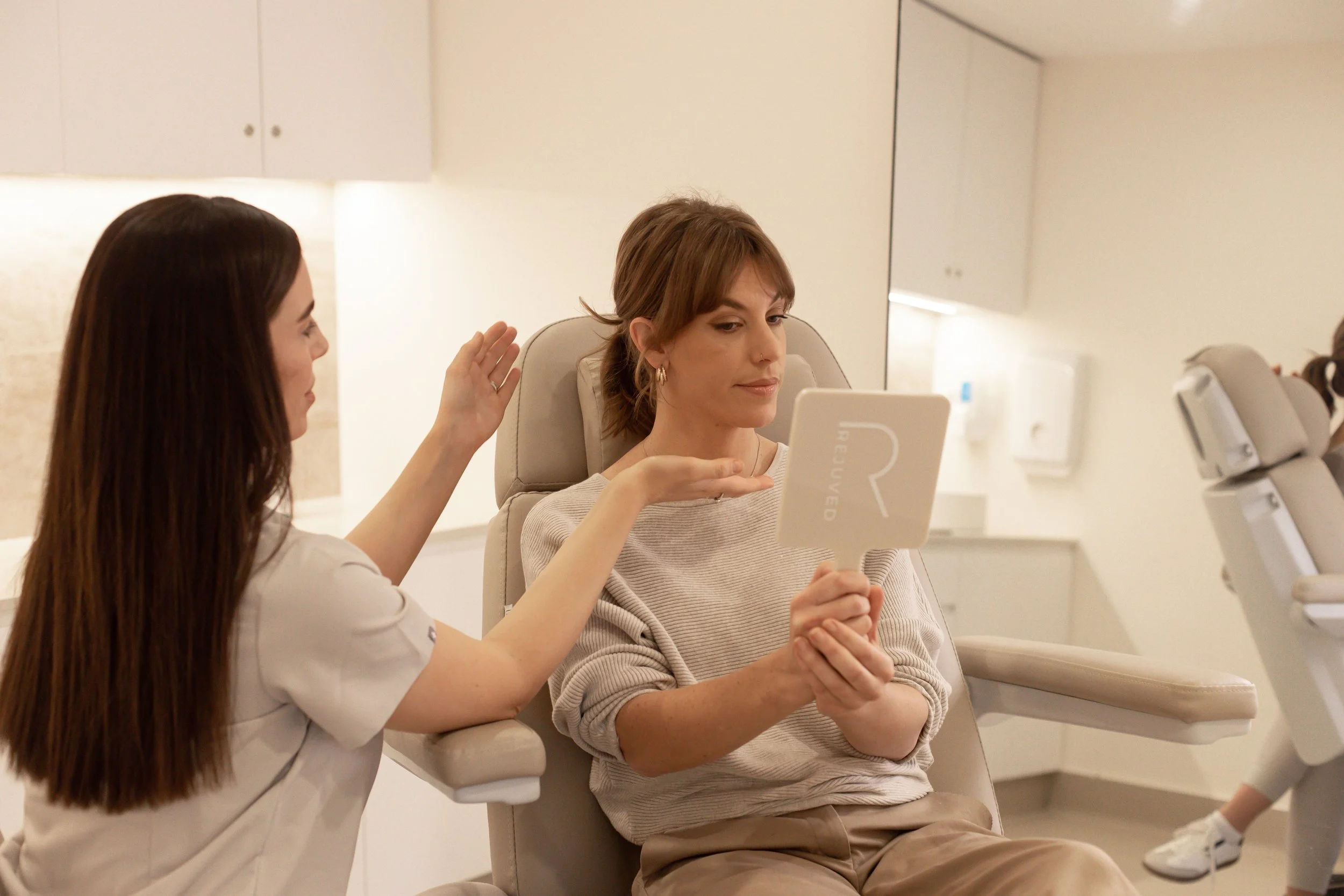
At Rejuved, we believe that understanding the anatomy and science of facial ageing is the foundation of any meaningful skin or aesthetic consultation. Our approach begins with listening — understanding your concerns, your goals and what has changed for you over time — before moving into a thorough assessment of your skin and facial structure.
Whether you are in your 30s noticing the early signs of change, or in your 50s looking to address more established concerns, we take the time to explain what we observe and discuss what options are available to you — from cosmeceutical skincare and in-clinic skin treatments through to a broader aesthetic consultation.
