
If you’ve noticed a reddish-brown, mottled discolouration on the sides of your neck or across your chest — one that doesn’t fade over winter and seems to stop neatly under your jawline — you’re not alone. It’s something we see often in clinic, and it has a name: Poikiloderma of Civatte.
Living on the Central Coast, most of us have spent years enjoying the sunshine, often without giving our neck and décolletage the same care we give our face. Poikiloderma is one of the ways long-term sun exposure shows up on this thinner, more delicate skin. It’s a chronic condition, but with the right combination of laser treatment, homecare and diligent sun protection, its appearance may be improved.
In this guide, we explain what Poikiloderma of Civatte is, why it happens, and how we approach treatment at Rejuved.
What Is Poikiloderma of Civatte?
Poikiloderma of Civatte (pronounced poy-kil-oh-DER-ma of see-VAT) is a common, benign skin condition first described in 1923 by the French dermatologist Achille Civatte. It’s characterised by three changes occurring together in sun-exposed skin:
Redness from small, dilated blood vessels (telangiectasia)
Brown pigmentation that often looks mottled or net-like
Thinning of the skin, which can leave the area looking slightly crepey or shiny
It typically appears symmetrically on the sides of the neck, and can extend across the upper chest and occasionally onto the sides of the cheeks. One of its most recognisable features is that the shaded area under the chin is usually spared — a clue to just how big a role the sun plays.
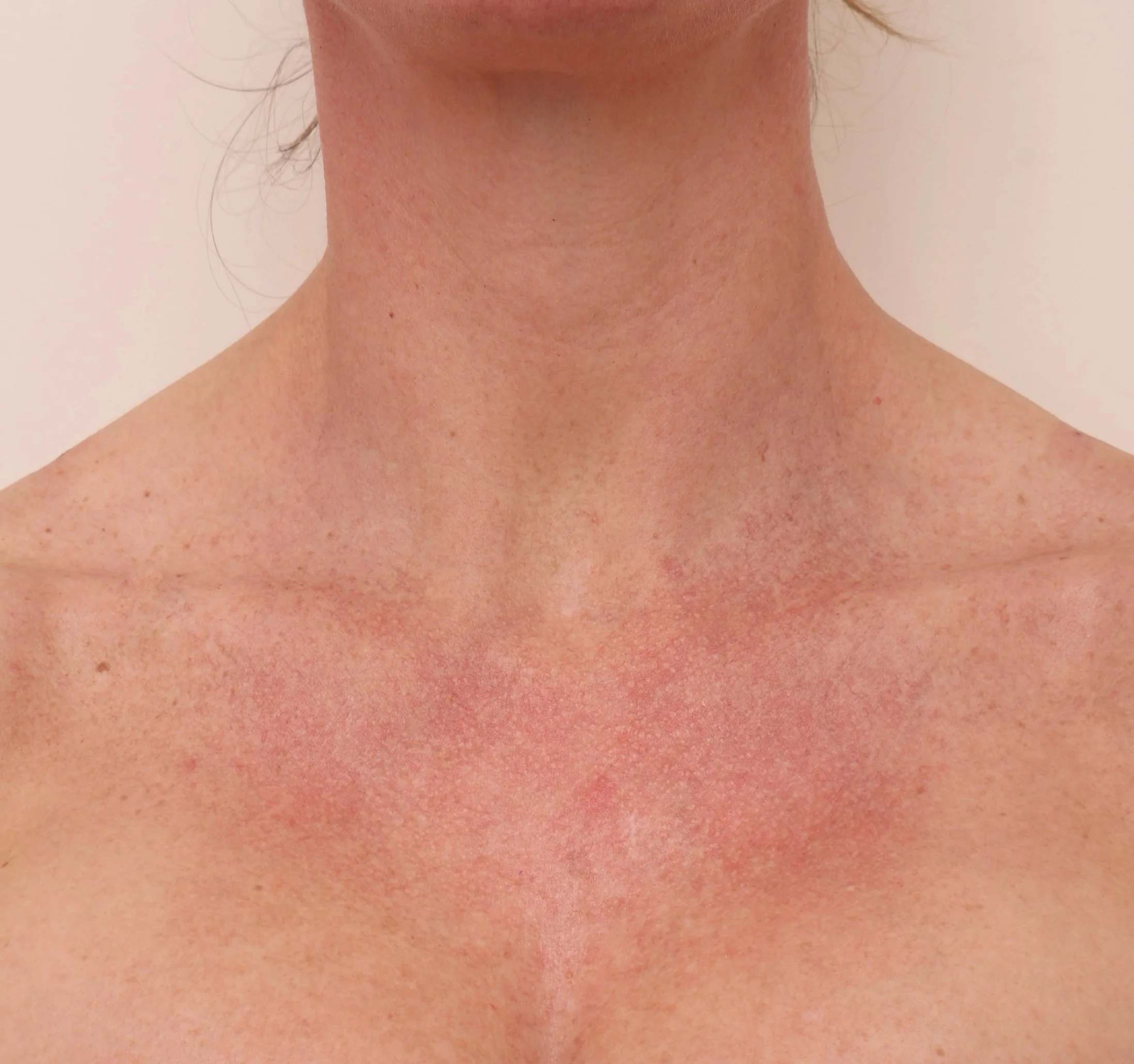
Poikiloderma of Civatte on the neck and upper chest of one of our patients, shared with her permission.
What Causes It?
The exact cause isn’t fully understood, but long-term sun exposure is considered the main contributing factor. Other factors thought to play a part include:
Fair skin that burns easily
Hormonal changes, particularly around menopause
Photosensitising ingredients in perfumes, cosmetics and toiletries — one reason spraying perfume on your neck before heading outdoors isn’t ideal
A genetic predisposition
It’s most common in fair-skinned women in middle age and beyond, although men can develop it too, and it’s seen more often in high-UV environments like Australia.
Is It Harmful?
Poikiloderma of Civatte is benign and usually doesn’t cause symptoms, although some people notice mild itching, burning, flushing or sensitivity in the area. For most people, the concern is how it looks — it can make the neck and chest appear more weathered than the face.
That said, skin that has had a lot of sun is also at higher risk of skin cancer, and a few other conditions can look similar to poikiloderma, so a proper assessment matters. Before treating any pigmentation, our team will assess your skin carefully, and if anything looks unusual we’ll ask you to see your GP or a dermatologist first. If you notice a spot that is new, changing, bleeding or not healing, please book a skin check — laser treatment is never a substitute for one.
How We Treat Poikiloderma at Rejuved
Because poikiloderma involves both redness and brown pigment, treatment needs to address both. Laser and light-based therapies are considered the most promising way to improve its appearance, and at Rejuved our treatment of choice is the Excel V+ laser.
The Excel V+ Laser
The Excel V+ by Cutera is a medical-grade laser we use for redness, visible capillaries and pigmentation. Its 532 nm wavelength is absorbed by both haemoglobin (the red in blood vessels) and melanin (brown pigment), which means it can target both the redness and the discolouration of poikiloderma. A second, deeper-acting 1064 nm wavelength can also be used where needed.
The skin on the neck and chest is thinner and heals more slowly than the skin on your face, so it needs a more conservative approach. Your clinician will tailor the settings to your skin type and the area being treated.
You can read more about the Excel V+ on our redness and vascular laser and pigmentation laser pages.
The photos below show one of our patients before and four weeks after a single Excel V+ treatment. Everyone’s skin responds differently, and most people need a series of treatments.
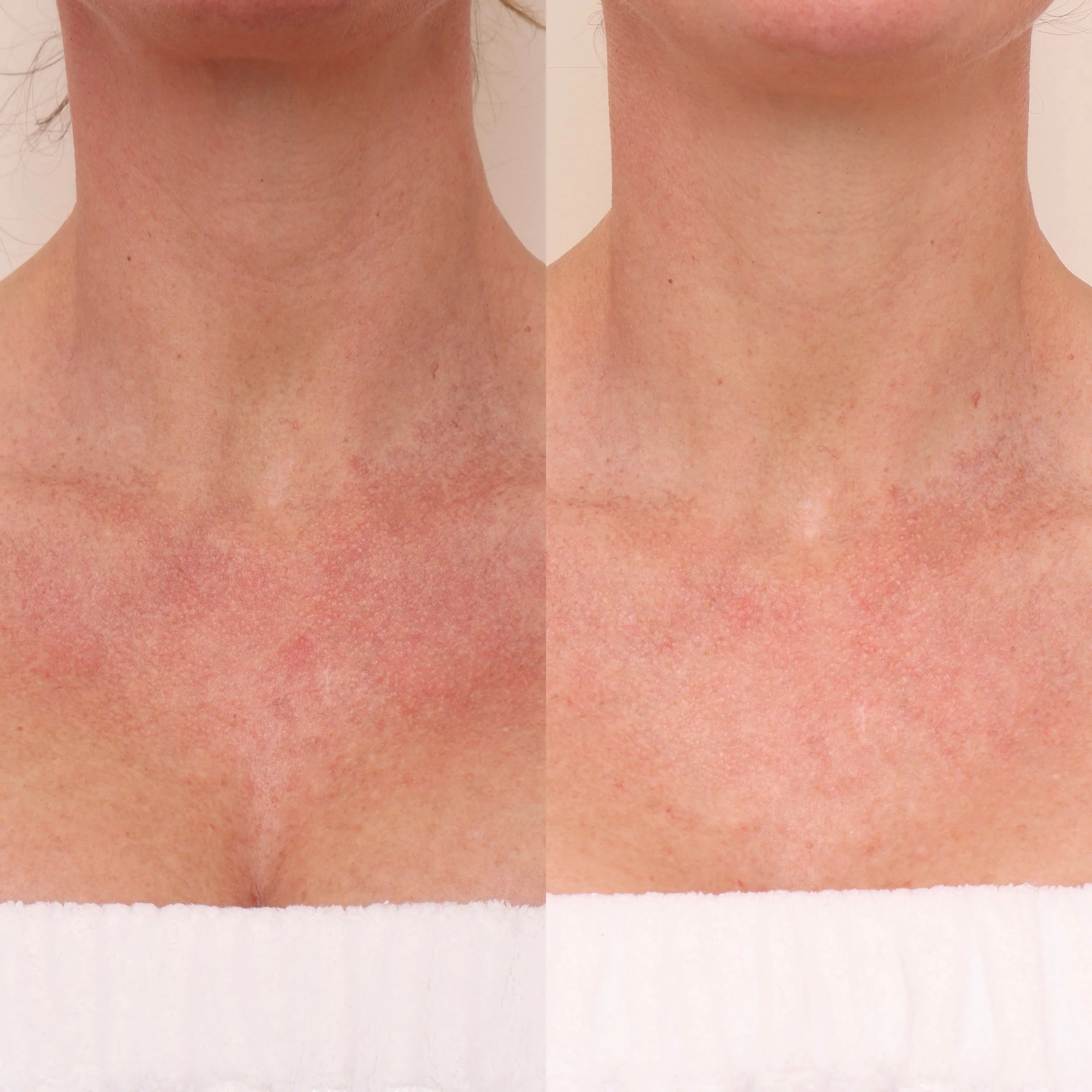
Before (left) and 4 weeks after (right) one Excel V+ treatment. These results are specific to this patient and individual results vary. Shared with her permission.
Is It Right for Me?
Your treatment starts with a redness laser consultation, where we’ll assess your skin and talk through your medical history, any medications and your sun habits. The Excel V+ is best suited to fairer skin types. Tanned skin can’t be treated, and because this wavelength also targets pigment, darker skin types carry a higher risk of pigment changes — we’ll talk you through the most appropriate options for your skin.
What to Expect During and After Treatment
Most people describe a brief snapping or warming sensation with each pulse of the laser. Afterwards, it’s common to have:
Redness and swelling for a day or two — a “bug bite” look is normal
Brown areas that darken before flaking away over the following one to two weeks (this can take a little longer on the neck and chest than on the face)
Bruising or crusting in some cases
Less commonly, blistering or changes in pigment (lighter or darker patches) can occur, and scarring is rare. We’ll go through the risks and recovery with you in detail at your consultation.
How Many Treatments Will I Need?
Poikiloderma usually needs a series of treatments rather than a single session, typically spaced four to six weeks apart. Improvement is gradual, it can be stubborn to treat, and every person’s response is different — your clinician will recommend a plan based on your skin.
Because it is a chronic condition, the aim is improvement rather than a cure. Without ongoing sun protection it can return, and some people choose occasional maintenance treatments.
Preparing for Your Treatment
Avoid sun exposure, tanning beds and fake tan on the area for four weeks beforehand
Stop retinol, AHAs, BHAs and other active or irritating products on the area for two to three days beforehand
Arrive with clean skin — no perfume, body lotion or makeup on your neck and chest
Let us know about any new medications, as some can make the skin more sensitive to light
Aftercare
Apply a broad-spectrum SPF 50+ to the area every day and avoid direct sun
Avoid heat — saunas, spas and hot yoga — for one to two days
Avoid active or irritating products on the area for two to three days
Don’t pick or scrub at darkened pigment — let it flake away naturally
Contact the clinic if you notice blistering or anything that concerns you
Your Homecare Matters Just as Much
Laser treatment works best alongside good daily habits. These are the ones we talk about most with our poikiloderma patients:
Take your SPF all the way down. Apply a broad-spectrum SPF 50+ to your neck and décolletage every morning, and reapply when you’re outdoors. Most of us are diligent with our face — the neck and chest are often forgotten.
Keep fragrance off your neck. Avoid spraying perfume onto your neck and chest, and choose fragrance-free products for the area.
Cover up. A broad-brimmed hat, collared shirt, light scarf or UPF clothing all help protect the area.
Treat your neck as an extension of your face. The right active ingredients can support a more even-looking skin tone, but neck skin is thinner and more reactive, so introduce actives slowly. Our team can tailor a homecare plan for you, and you can read more in our guide to key skincare ingredients for sun-damaged skin.
Frequently Asked Questions
Can Poikiloderma of Civatte be cured?
It’s a chronic condition, so the goal is to improve its appearance rather than cure it. Daily sun protection is key to maintaining your results, and some people have maintenance treatments over time.
Does laser treatment for poikiloderma hurt?
Most people describe a brief snapping or warming sensation with each pulse. Comfort levels vary from person to person, and your clinician will check in with you throughout.
Is there downtime?
Expect redness and swelling for a day or two, and darkened pigment that flakes away over one to two weeks — sometimes longer on the neck and chest. Most people continue with their usual routine, but you’ll need to keep the area out of the sun and away from heat while it heals.
Can I have treatment in summer?
The area needs to be untanned, and you’ll need to protect it from the sun before and after each session. Many people find the cooler months easier, and your clinician will advise on the best timing for you at your consultation.
Do I need a consultation first?
Yes. Every Excel V+ treatment at Rejuved starts with a redness laser consultation to confirm the laser is suitable for your skin and to create your treatment plan.
Book a Redness Laser Consultation
Your consultation is $100 and includes a full skin assessment and treatment plan with our nurse. If you’re suitable and choose to go ahead with treatment on the day, the $100 comes off your treatment. If treatment doesn’t go ahead on the day, the $100 covers your consultation. Treatment pricing depends on the area and is confirmed at your consultation.
If you’re ready to better understand your skin and take a more intentional approach to your treatment journey, we’re here to guide you.
Book a consultation with our team and start your Rejuved journey today.
This article is general information only and isn’t a substitute for personalised medical advice. Treatment suitability, risks and outcomes vary from person to person and will be discussed at your consultation.
